Stay Informed: Updates, Events and Stories
Learning by Doing

by DENISE WOLFE
Published January 5, 2026
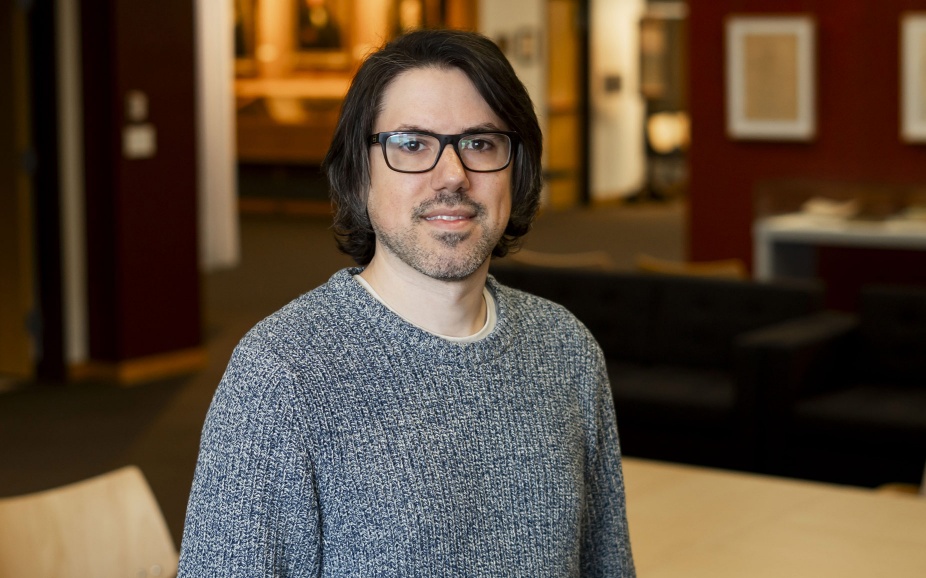
Graduate student assistant Jordan Stanford has long been drawn to libraries. As an English major at UB, he spent hours writing in quiet study areas and exploring the Poetry Collection’s rare books. Now, a Master of Library and Information Science (MLIS) student and student worker in the University Libraries, he’s contributing to projects that bring those historical materials to life for others.
Stanford, who earned a bachelor’s degree in English and a creative writing certificate from UB in 2016, returned to the university in fall 2024 after working in a variety of roles, including as a state contact tracer during the COVID-19 pandemic. With a renewed focus and interest in librarianship, he rejoined the library and information science program and soon secured a practicum in Digital Collections, where materials such as photographs, documents and other resources are digitized, preserved and made available online to support teaching, research and long-term access.
Working with Digital Asset Librarian Reed Jones and Visiting Assistant Librarian Thomas Murphy, Stanford helped build the digital collection for the Matzinger materials, part of the Robert L. Brown History of Medicine Collection. The items document Dr. Herman G. Matzinger’s bacteriological investigation into the death of President William McKinley following the Pan-American Exposition. Stanford scanned materials, transcribed journal entries and created metadata to prepare the collection for online access. “It was really interesting to go through the journal and see that history firsthand,” he said.
He also assisted with accessibility remediation efforts, using generative AI tools to create detailed image descriptions for rare materials. One of his most memorable assignments involved drafting descriptions for The Defence of Guenevere, a rare volume housed in the Poetry Collection. Later, during a visit to Special Collections, he had the chance to see the book in person. “It was really cool to actually hold the materials I had only seen digitally,” he said. “You notice so many more details up close.”
Since completing the practicum, Stanford has continued working in the libraries on additional projects, including scanning Frank Lloyd Wright blueprints of the Darwin D. Martin House. He says the experience has helped him better understand how coursework connects to real-world library work and has given him insight into the many behind-the-scenes roles that support access to information.
Stanford works about 15 hours per week in the libraries and appreciates the supportive community he has found across departments. Outside of work, he enjoys digital illustration, creative writing and spending time with his energetic Shih Tzu, Truman.